
Data Center Power
Methane is Escaping the Data Center Conversation

Erik Freer, PhD

As AI developers turn to reciprocating engines for onsite power, an overlooked emissions problem is coming with them: methane slip. Across 16 gas-powered data center projects we reviewed, only one disclosed project-level methane emissions and that number put it on the scale of the Aliso Canyon disaster.
ARTICLE
On July 1, the Environmental Integrity Project (EIP) put a useful number on the behind-the-meter buildout forming around AI: 74 proposed natural-gas power plants dedicated to U.S. data centers, totaling 143 GW. We went looking inside those plants and corroborated reciprocating engines in 16 projects representing more than 21 GW of planned project capacity.
That matters because reciprocating engines bring an emissions problem that is easy to miss in the data-center power conversation.
The fuel does not all burn. Some of it leaves the stack as methane.
Engine people call it methane slip. And we wanted to find out if the projects that used this type of natural-gas engine disclosed how much methane could slip through their exhaust. In 15 of the 16 projects, we could not find a public disclosed project-level methane mass.
The one exception was extraordinary.
An 864-engine project in West Virginia puts roughly 38,000 metric tons of methane a year on paper in its permit calculation. At that applicant-calculated potential-emissions rate (ref), the project accumulates the methane mass released at Aliso Canyon — the worst natural gas blowout in U.S. history — every ~2.7 years.
Our broader screen using EPA emissions factors across the 16-project set produced an eye-popping estimate: roughly 851,000 metric tons of methane a year under the assumptions in that analysis. That is enough to accumulate the methane mass of Aliso Canyon every 1.5 months.
That second number requires an important qualification. It is a screening calculation, not measured emissions or a forecast. Some of the 16 projects have mixed generating fleets, and the more than 21 GW is total project capacity, not 21 GW of reciprocating-engine capacity. Real engine counts, loads, operating hours and methane rates will differ.
But that uncertainty does not make the question smaller. It makes measurement more important.
A potentially enormous new methane source is arriving with the data-center gas buildout, and methane is barely present in the public air-pollution conversation around it.
The asymmetry is particularly strange because these engines already have exhaust-control systems. The hardware is much larger and more complicated, but the basic idea is familiar to anyone with a catalytic converter under a car: combustion happens first, then equipment in the exhaust cleans up pollutants before they reach the atmosphere.
The one project that gives us enough public information to look closely makes the gap visible. Its calculation credits 98% control for carbon monoxide, >98% for NOx and ~80% for VOCs.
Methane gets none. Zero.
That does not prove the installed catalyst physically destroys zero methane. It suggests what is expected. But it exposes the larger problem: methane slip is arriving with this generation fleet without the mature measurement-and-control framework already applied to other pollutants.
That should matter even to people who want more reciprocating engines, not fewer.
Engine manufacturers are expanding capacity because data-center developers increasingly want these machines. The opportunity is to preserve whatever operational advantages are driving that adoption while removing an avoidable emissions liability. If methane can be measured and controlled alongside CO, NOx, formaldehyde and other exhaust pollutants, operators do not have to choose between the reasons they selected reciprocating generation and better climate performance.
The problem is not that these engines burn natural gas. It is that some of the gas does not burn—and right now, we are doing remarkably little about what leaves the stack.
Disclosure: Endaris is developing exhaust aftertreatment intended to reduce methane and other pollutants from lean-burn natural-gas engines with a novel catalyst to address it passively. We have a commercial interest in this problem being measured and controlled. AI is an enormous opportunity but data center growth needs to be done responsibly. We expect gas to remain part of the power mix for decades. Our argument is not to stop building. It is to make the machines we build cleaner.
The gas plant is not always a turbine
Say “gas-fired data-center power” and the mental picture is usually a turbine. The market is already more complicated. Among U.S. data-center projects tracked by BloombergNEF that plan to use onsite natural gas and have disclosed timelines, 29% plan to use reciprocating engines, compared with 55% expecting gas turbines, according to reporting on BNEF’s project data.
Our first pass through EIP’s inventory found 20 projects representing roughly 33 GW of total project capacity where reciprocating engines appeared somewhere in the generation plan. We then removed projects where we could not corroborate the technology from a permit, developer or engine manufacturer. Sixteen remained, representing more than 21 GW of project capacity. Again, some use mixed fleets; the 21 GW should not be read as 21 GW of reciprocating engines.
The manufacturing evidence points the same way. In July, INNIO announced an approximately 1.1 GW order for behind-the-meter prime power using more than 200 Jenbacher gas engines for U.S. data-center projects. Caterpillar has also been expanding its large-engine manufacturing footprint and says rising large-reciprocating-engine sales are being driven primarily by data-center power generation.
Factory expansions are forecasts backed by order books.
Engine manufacturers are putting capital behind the proposition that reciprocating generation will be part of data-center infrastructure, not merely a temporary response to grid constraints. That makes the emissions profile of these machines more consequential.
The methane is not hypothetical
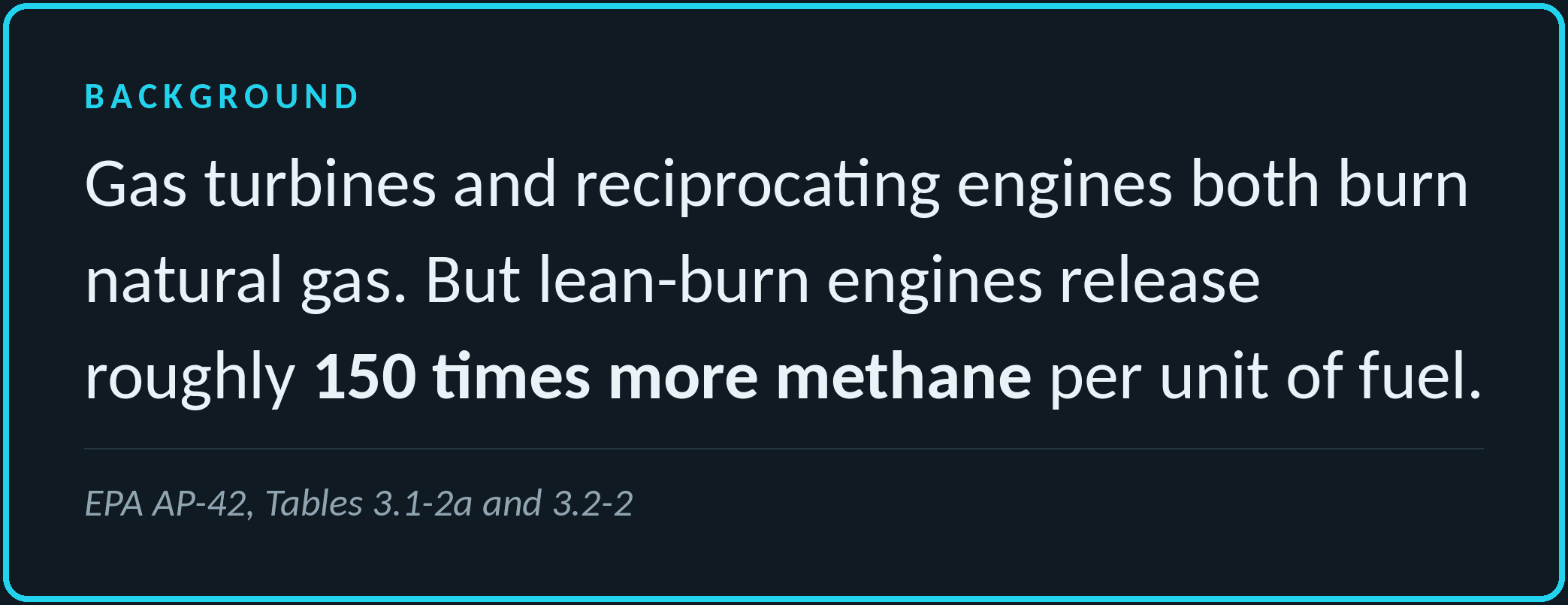
Methane slip is established enough that EPA publishes an emission factor for it. AP-42, the agency’s standing compilation of air-emission factors, assigns four-stroke lean-burn natural-gas engines a methane factor of 1.25 pounds per MMBtu of fuel input.
That factor is not a measurement of every modern engine. It is a population-level screening tool. Manufacturers publish methane values for individual products under specified operating conditions, and permit applications often use those instead. Neither should be confused with a post-control stack measurement from the engine actually operating at the site.
That distinction becomes concrete at Monarch Cloud Campus’s proposed Point Pleasant project in West Virginia. The permit application covers 864 Caterpillar G3520K natural-gas engines with roughly 2.16 GW of generation capacity.
This is not a row of emergency generators waiting for the grid to fail.
It is a power plant made from hundreds of engines.
Among the 16 projects in our screen, Point Pleasant is the only one where we found a public project-level methane mass. The applicant calculates approximately 41,900 short tons per year, or about 38,000 metric tons, for the engine fleet. Potential-to-emit is not measured actual emissions. It is a permitting calculation based on defined assumptions and functions as a ceiling rather than a forecast.
But here, at least, methane finally appears on the page.
The applicant does not use AP-42. It uses a Caterpillar methane factor of 1.43 grams per brake horsepower-hour. Converted into comparable units, that is roughly half a pound per MMBtu—about 44% of EPA’s factor for the engine class. Applying AP-42 to the same fleet produces roughly 2.3 times the applicant’s methane estimate.
But the two numbers are not measuring the same thing. A manufacturer factor describes an engine as delivered — new, correctly tuned, at rated load. AP-42 describes engines in service, at all loads, across a population that includes units decades old. Slip does not stay where it starts. It rises with ring and liner wear, with valve and timing drift, with fouled plugs and degraded aftertreatment, and with the part-load operation any real duty cycle involves.
The honest expectation is that a data-center engine starts near Caterpillar's number and drifts toward EPA's across an asset life measured in decades.
Where the methane actually lands is a measurement question.
Aliso Canyon puts the number at human scale
The Aliso Canyon natural-gas-storage blowout near Los Angeles began in October 2015 and continued for 112 days. The peer-reviewed estimate put the release at 97,100 metric tons of methane; California’s final regulatory estimate was 109,000 metric tons. The consequences extended well beyond the methane total: at its peak the blowout doubled the Los Angeles Basin’s methane emission rate, thousands of households were temporarily relocated amid reported respiratory and other acute symptoms.
Now compare this blowout to Point Pleasant’s applicant-calculated methane emissions to the average of the estimated release:
103,050 ÷ 38,021 = 2.7 years
One proposed 864-engine phase therefore puts an Aliso Canyon’s methane mass on the ledger every 2.7 years on the applicant’s own potential-emissions case.
Aliso Canyon gives scale to a number that otherwise has little intuitive meaning. The larger fleet screen makes the same point differently: under the assumptions in that AP-42 analysis, the 16-project set reaches an Aliso-sized methane mass every 1.5 months.
It’s an estimate with a result we should treat it as a reason to demand the actual missing methane emission numbers.
The missing control step
Point Pleasant makes the engineering opportunity unusually clear. Its permit calculation assumes 95–98% control for several conventional pollutants while crediting no methane control. We already expect operators to clean engine exhaust after combustion. Methane should become part of the same engineering conversation.
There is an argument that actual methane emissions will be lower than the screens presented here. Modern engines may outperform AP-42. Actual duty cycles may be below potential-to-emit cases. Existing aftertreatment may already destroy some methane. The Point Pleasant fleet may never operate at its permitted ceiling.
Good. Measure it.
If those things are true, representative post-control stack testing should show them, and the Aliso clock will slow substantially. We would welcome that result. What would change our view is testing across modern engines, representative loads and installed control systems showing that post-control methane is consistently small—and public permits and applications routinely documenting that performance.
Until then, data-center projects using reciprocating engines should disclose the methane emission factor or measured rate, the operating conditions behind it, whether the number is engine-out or post-control and, where methane control is claimed, the destruction efficiency.
This is not an argument to stop building data centers or to abandon reciprocating generation. There does not need to be a choice between technological and environmental progress. We can add clean generation, use gas where it is needed, build AI infrastructure quickly and preserve the attributes that are making reciprocating engines attractive.
We just need to stop treating the methane that does not burn as though it does not exist.
EIP counted the gas plants. We counted the engines.
Now count—and control—what leaves the stack.
REFERENCES
1. Environmental Integrity Project, The Power Behind AI, July 1, 2026. https://environmentalintegrity.org/reports/the-power-behind-ai/
At least 74 planned natural-gas power plants dedicated to U.S. data centers, 143 GW of generating capacity and 662 million tons per year of greenhouse-gas pollution. EIP also publishes a project-by-project spreadsheet of pollution and demographic information with links to public records: https://environmentalintegrity.org/wp-content/uploads/2026/07/Spreadsheet-of-Data-Center-Power-Plants-for-EIP-Report.xlsx.
That spreadsheet does not carry a methane column. It is the most detailed public inventory of this buildout, it records the pollutants that permits require operators to report, and methane — a short-lived climate super-pollutant roughly 80 times as potent as CO₂ over 20 years — is not among them. The omission is not EIP’s error. It reflects what the underlying permit records contain.
2. Monarch Cloud Campus, LLC, Updated Site Emissions, filed with the West Virginia Department of Environmental Protection, Division of Air Quality, May 8, 2026. PSD application R14-0042, Facility ID 053-00136, Mason County, WV. https://apps.dep.wv.gov/Documents/DAQ/NSRPermits/053-00136/Draft/MCC%20-%20Updated%20Site%20Emissions%205-8-2026.pdf
Methane appears in the Caterpillar G3520K RICE Normal OPS (EU1–EU864) emission-factor table: 1.43 g/bhp-hr, basis “Manufacturer Data,” 3,513 rated bhp, 5,716 Btu/hp-hr, 8,725 annual operating hours, control efficiency 0%, 41,743.91 tpy. The companion SSM table adds 35 hours and 167.45 tpy. Engine-fleet total: 41,911.36 short tons per year, or 38,021 metric tons. Control efficiencies in the same column: CO 98%, NOx 98%, formaldehyde 95%, non-methane non-ethane hydrocarbons 80%, non-methane hydrocarbons 60%.
3. U.S. Environmental Protection Agency, Compilation of Air Pollutant Emission Factors (AP-42), Fifth Edition, Volume I, Section 3.2, “Natural Gas-Fired Reciprocating Engines,” October 2024 revision. https://www.epa.gov/system/files/documents/2024-10/c03s02_2024-update_0.pdf
The methane factor for uncontrolled four-stroke lean-burn engines — 1.25 lb/MMBtu — is in Table 3.2-2, quality rating C. The October 2024 revision updated front matter and disclaimer language; the underlying factors date to Supplement F, July 2000. EPA states in the same section that these factors are not intended as source-specific permit limits, that using them as such could leave roughly half of sources in noncompliance, and that source testing is recommended for the best possible emission values.
4. ERM, MCC Point Pleasant Campus Air Dispersion Modeling Report, prepared for Monarch Cloud Campus, LLC, May 29, 2026; WVDEP NSR docket, Facility ID 053-00136.
Independently confirms 2.16 GW across 864 Caterpillar G3520K engines at 2.5 MW each, selective catalytic reduction and an oxidation catalyst on every unit, 8,725 hours of normal operation plus 35 hours of startup and shutdown, and continuous islanded-microgrid duty. The report models CO, NO₂, PM₁₀, PM₂.₅ and SO₂. It does not model methane, which has no ambient air quality standard.
5. Conley, S., et al., “Methane emissions from the 2015 Aliso Canyon blowout in Los Angeles, CA,” Science, 2016 — 97,100 metric tons. California Air Resources Board final estimate — 109,000 metric tons.

